


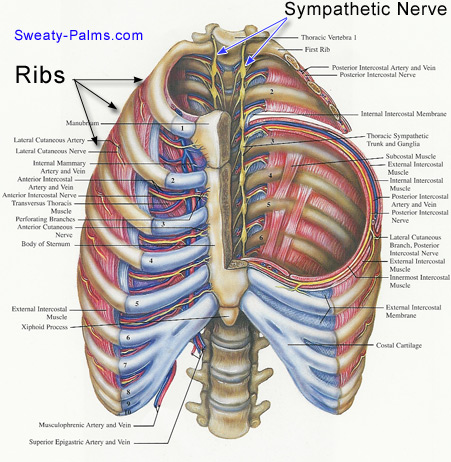
As the name “Hyper” implies, hyperhidrosis is the production of sweat that goes beyond what the bodies needs. Hyperhidrosis in general is excessive sweat production. The process of sweat production is controlled partly by the bodies sympathetic nervous system. This nervous system is involuntary and maintains the five million or so sweat glands throughout the body. For the purpose of this page we are going to focus on localized hyperhidrosis which is excessive sweating that affects three main areas of the body:
Localized hyperhidrosis, medically known as focal hyperhidrosis, is a condition known to have a genetic family history whether it is of the palmoplantar or whole body nature. This means a gene, for which the location is known, is creating this condition. Knowing the location does not mean that we have a direct way to manipulate this gene. Hopefully in the future, when more knowledge is obtained, a direct manipulation of this gene might give us a better way to treat it. So far clinical studies have shown that more than 50% of those who suffer from hyperhidrosis have a family history of it. Sometimes the condition can skip generations, or it can skip family members making, it more difficult to detect the family history. Also due to the embarrassing nature of the condition family members may not always be open about having it.
How to stop sweating
How do you stop the sweating? Anyone who suffers from this condition should start with conservative, noninvasive surgery or treatment methods. There are several options:
- Topical Lotions & Deodorants
- Oral / Prescription Medications
- Electrical Devices / Treatment
- BOTOX® Cosmetic Injections
- Psychological
For moderate to severe cases of excessive sweating the above treatments have a low/limited success rates.
Surgical Approaches to Stop Sweating
Since the 1990s the advancement of technology has enabled surgeons to treat hyperhidrosis with a very high success rates using new and latest methods. These full operations are performed on an outpatient basis (patient leaves the center on the same day once treated) with high safety standards, minimal amount of pain and a much higher satisfaction rate over the years. These surgeries are the best known methods to provide good, long lasting solutions (permanent for many) with low recurrence rates.
Surgeries for each type of localized hyperhidrosis:
- ETS for the hands (palmar hyperhidrosis)
- ELS for the feet (plantar hyperhidrosis)
- Axillary suction curretage (armpit sweating only)
The Future of Hyperhidrosis Treatment
Obviously because of the genetic nature of hyperhidrosis the best theoretical solution will be a genetic one. As of right now we are offering a mechanical solution for a physiological problem which has great success rates but is not perfect. When a genetic solution is found then hopefully the treatment of hyperhidrosis will be even better. That being said surgeons, including Dr. Reisfeld, are continually evaluating, researching, and working towards improved solutions.
Stop Excessive Sweating Now!
Contact Us To Learn About The Cure
Dr. Reisfeld has authored several studies on the topic of hyperhidrosis in medical journals, reviewed by other experts in the field, and has been interviewed by several TV programs (CBS, FOX, 48 Hours, Life Moments). In addition, Dr. Reisfeld has contributed material in many publications (Newsweek, Heart & Soul). Dr. Reisfeld has exceedingly improved upon the clamping method by creating an even safer and more effective surgical procedure to treat this ailment. Learn more about Doctor Reisfeld’s Hyperhidrosis research.